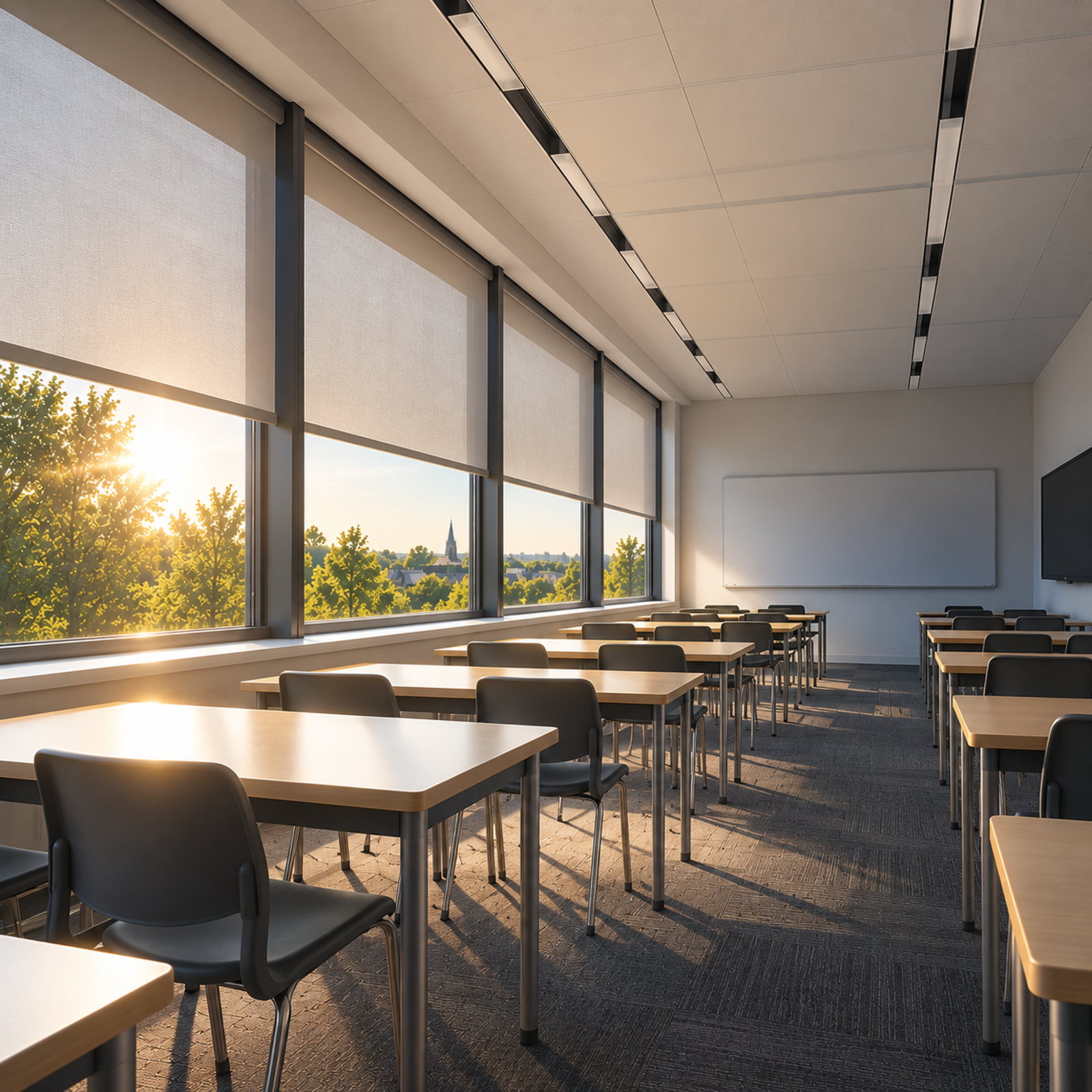
Predicting glare & visual comfort
Daylight can transform the quality of an internal environment, but direct sunlight and high luminance contrasts can also create periods of visual discomfort and glare.
Lighting Analysts use detailed sunlight and daylight simulation to predict when and where direct sunlight may enter a building throughout the year, and to assess the potential for daylight glare from specific observer positions and viewing directions.
Using Daylight Glare Probability (DGP) analysis, we can identify problematic times, locations and views, test alternative design solutions and support the development of effective glare-control strategies.
Predict the problem. Test the solution.
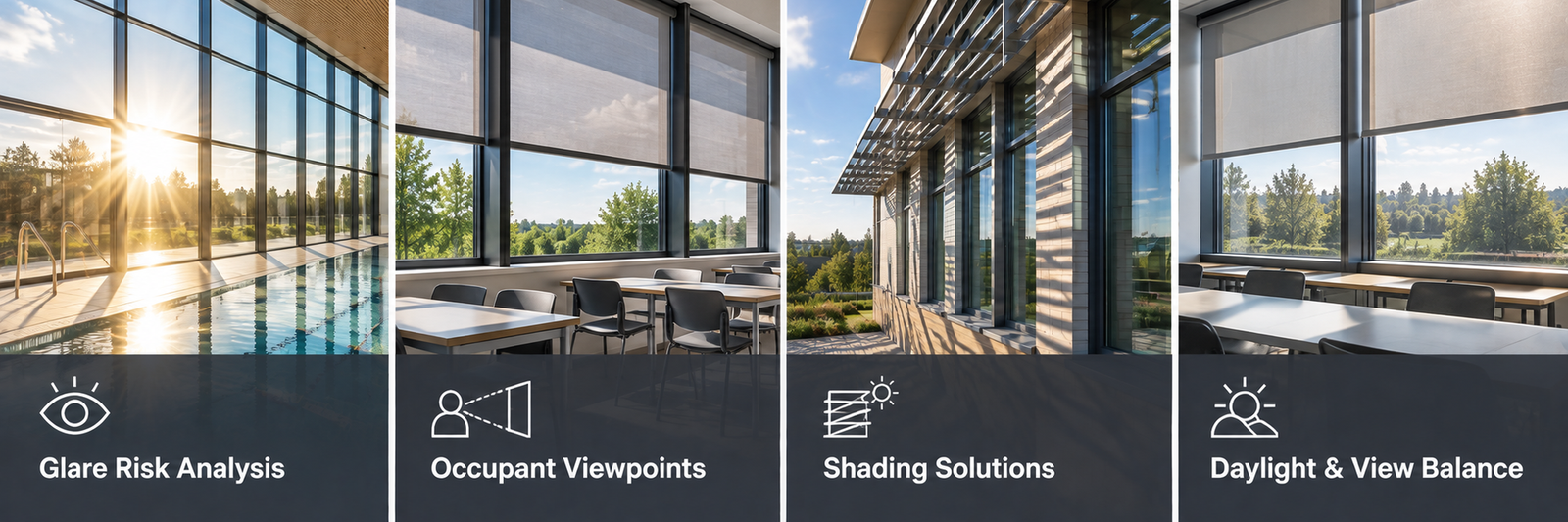
The most effective strategies often combine several layers of protection, using the building form, glazing and passive shading to reduce the underlying glare risk, supplemented where necessary by active devices such as adjustable blinds or screens.
Our role is to use simulation to understand the source and timing of the problem, then test different approaches to find a solution that balances daylight, view, solar control and visual comfort.
We help develop the shading strategy — not simply identify the glare.
Sunlight penetration studies allow us to predict where direct sunlight will enter a building and how this changes with time of day and season.
By simulating the movement of the sun throughout the year, we can identify:
- periods when direct sunlight reaches occupied areas;
- the depth of sunlight penetration;
- façades and spaces most exposed to low-angle sun;
- critical times of year;
- the effect of surrounding buildings and landscape; and
- the performance of proposed shading devices.
This can be particularly useful in spaces such as classrooms, offices, swimming pools, sports facilities, galleries and other environments where direct sunlight may affect visual comfort or use of the space.
Daylight Glare Probability (DGP) is a metric used to predict the likelihood of discomfort glare caused by daylight.
The assessment considers the brightness, size and position of glare sources within an observer's field of view, together with the overall vertical illuminance reaching the eye.
Unlike an illuminance calculation alone, DGP therefore considers what an occupant is actually likely to see from a particular position and viewing direction.
This makes it particularly useful for evaluating glare from windows, direct sunlight, bright sky conditions and reflections.
Glare is dependent upon both where a person is positioned and the direction in which they are looking.
A space may therefore present little glare risk from one viewpoint while producing severe discomfort from another.
We establish representative observer positions and viewing directions based on the intended use of the space. These may include teaching positions, workstations, circulation routes, seating areas or, in specialist environments such as swimming pools, critical lifeguard viewing positions.
Multiple views can then be analysed under selected sky and sun conditions to identify where glare is most likely to occur.
For each observer view, the simulation can calculate a Daylight Glare Probability value and identify bright sources within the visual field.
DGP is commonly interpreted using four broad categories:
Imperceptible — DGP below 0.35
Perceptible — DGP 0.35–0.40
Disturbing — DGP 0.40–0.45
Intolerable — DGP above 0.45
The results allow problematic viewpoints and conditions to be identified and compared systematically.
DGP should, however, be treated as a predictive design metric rather than an absolute measure of individual visual comfort. Occupant sensitivity, adaptation, activity and behaviour can all influence the perception of glare.
Glare does not occur uniformly throughout the year. The most severe conditions are often associated with particular combinations of sun altitude, façade orientation, sky condition and viewing direction.
We can therefore undertake both:
- Critical-condition studies
Detailed analysis of selected times representing potentially severe glare conditions.
- Annual or time-series studies
Assessment of how glare or sunlight exposure varies across a wider period of the year.
This allows the design team to understand not only whether glare could occur, but when, where and how frequently problematic conditions are likely to arise.
Simulation allows alternative shading strategies to be tested before they are incorporated into the building.
Options may include:
- architectural overhangs;
- brise soleil;
- vertical fins;
- external louvres;
- glazing specification;
- fritting or translucent interlayers;
- internal screen roller blinds;
- adjustable shading systems; and
- combinations of passive and active measures.
The effect of each option can be assessed against both glare and daylight performance, helping avoid a solution that controls glare at the expense of excessive daylight loss or poor outward views.
In many buildings, a multi-layer approach provides the most effective solution.
This may combine:
- Passive measures
Building orientation, façade geometry, glazing selection, external fins, overhangs or fixed shading.
- Intermediate measures
Diffuse glazing, fritting or other treatments that reduce the luminance of particularly bright areas.
- Active measures
Adjustable screen blinds or other occupant- or automatically-controlled shading used during critical conditions.
The objective is to reduce glare at source wherever practical while retaining useful daylight and outward views for as much of the occupied period as possible
Direct view of the sun is not the only potential source of daylight glare.
Highly reflective surfaces, water, neighbouring façades and internal materials can redirect sunlight into the visual field and produce intense localised glare.
Detailed rendered-view analysis can help identify these secondary glare sources and determine whether changes to shading, surface properties or viewing position could reduce the risk.
This is particularly relevant to swimming pools, where reflections from the water surface can become a significant component of the visual environment.
Services
Sunlight Penetration Studies
Annual and critical-date analysis to identify when and where direct sunlight enters a building or external space.
Daylight Glare Probability Analysis
DGP assessment from representative observer positions to identify potential discomfort glare and critical viewing conditions.
Glare & Viewpoint Studies
Assessment of glare risk from specific workstations, teaching positions, seating areas, circulation routes or specialist observer locations.
Shading Design & Optimisation
Testing and development of passive and active shading strategies, including glazing, external devices and internal screen blinds.
Comparative Design Studies
Side-by-side analysis of alternative façade, glazing or shading options to understand their effect on glare, daylight and outward view.
Compliance & Technical Reporting
Clear project-specific reporting of methodology, assumptions, observer positions, results and recommended mitigation measures.
Talk to Us
Early analysis can identify potentially problematic façades and viewing conditions before the glazing and shading strategy becomes fixed.
We can undertake sunlight penetration studies, detailed DGP analysis and comparative testing of glazing and shading options to help develop an effective visual-comfort strategy.
Discuss your project →