CBDM
Understanding daylight throughout the year.
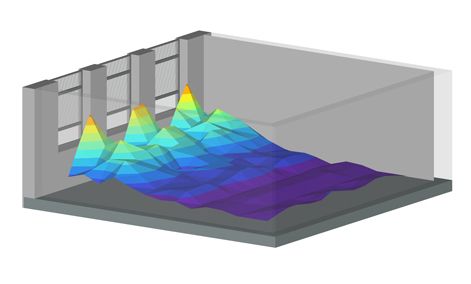
Climate-Based Daylight Modelling (CBDM) uses local weather data to predict how daylight will perform within a building throughout a typical year.
Unlike traditional daylight calculations based on a single overcast sky condition, CBDM considers changing weather, seasons, sun position and building orientation. This provides a much more realistic understanding of how daylight interacts with the architecture and how conditions vary throughout occupied hours.
At Lighting Analysts, CBDM forms the basis of our daylight consultancy. We use detailed annual simulation not simply to demonstrate compliance, but to understand how a building performs and identify opportunities to improve daylight quality through the design process.
We help inform the design - not just test it.

CBDM Metrics
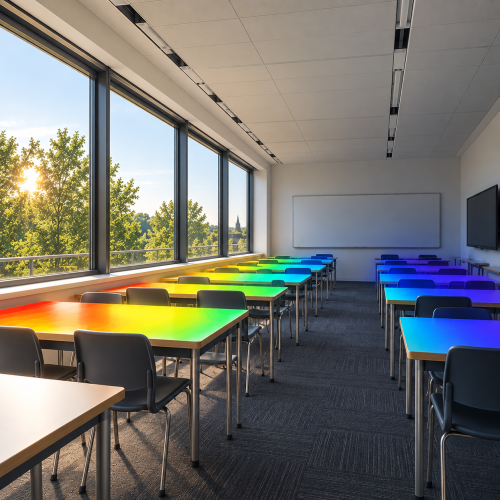
Daylight Autonomy (DA) is the percentage of time that a target illuminance level is achieved, or exceeded. The measure is typically taken across a year, during hours of operation. Theoretically, DA could be measured daily, weekly, monthly or any other time period. DA is typically measured across the working plane of a space, with DA values being calculated at each grid point.
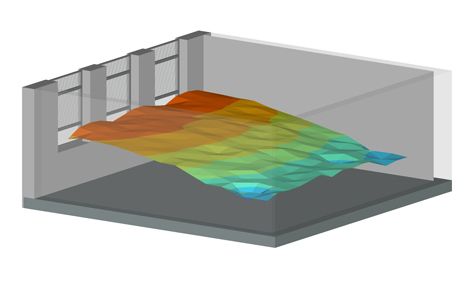
Spatial Daylight Autonomy (sDA) defines the percentage of time that a target illuminance (typically 300lux) is achieved across a defined percentage of floor area (typically 50%).
In England, the DfE requires and sDA (300/50%) ≥50% across at least 50% of the working plane, during occupied hours.
Useful Daylight Illuminance (UDI) is a measure of daylight availability, during hours of operation. Rather than a specific target illuminance, UDI analyses the percentage of time that a target range of illuminances can be achieved.
Typically, UDI is divided into three ranges; UDI-s (<100lux), UDI-a (100-3000lux), and UDI-e (>3000lux).
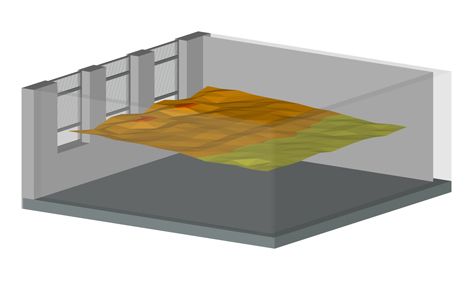
UDI-s (<100lux) is a measure of daylight availability, during hours of operation, below the target range of 100-3000lux.
In England, the DfE GDB specifies that the UDI-a (100-3000lux) should be ≥80% (ave), across the working plane of each space, during occupied hours. This means that the UDI-s & UDI-e cannot exceed 20% (combined).
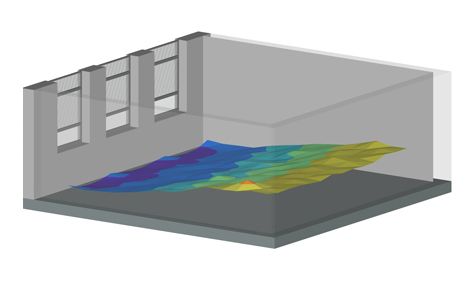
UDI-a (100-3000lux) is a measure of daylight availability, during hours of operation, within the target range of 100 - 3000lux.
In England, the DfE GDB specify that the UDI-a (100-3000lux) should be ≥80% (ave) across the working plane of each space, during occupied hours.
UDI-e (>3000lux) is a measure of daylight availability, during hours of operation, above the target range of 100-3000lux.
In England, the DfE GDB specify that the UDI-a (100-3000lux) should be ≥80% (ave) across the working plane of each space, during occupied hours. This means that the UDI-s + UDI-e cannot exceed 20% (combined).